
Why is avoiding a Wetting Issue so important?
Prewetting your cassette is a crucial step in achieving accurate results for parasite management. If the wetting issue is severe, it may hinder our ability to accurately count your eggs. In such cases, we might need to reject your submission, requiring you to repeat the process, which could delay the time it takes to receive your results.
What is a Wetting Issue?
When looking at the images of wells taken by the Micro-I 100, a wetting issue appears as a dark circle or blob around the rod in the well. Generally, it will have puckering and potentially uneven edges.
Here are some examples:
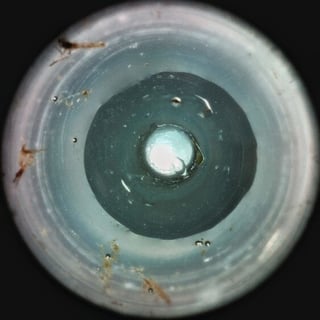
Above: A Severe Wetting Issue
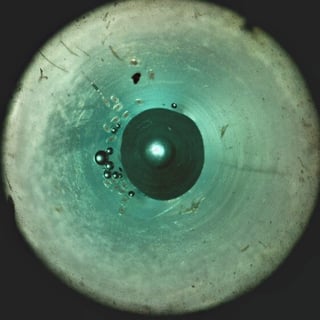
Above: A Minor Wetting Issue
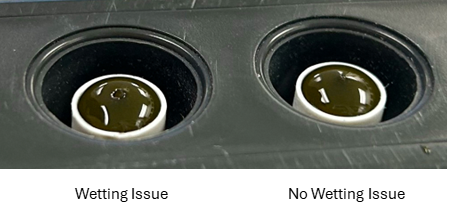
Often a wetting issue can be seen before imaging, by looking at the wells after filling. When looking with your eye, a wetting issue appears as sample ‘getting stuck’ partway down the Rod, or caving in towards the rod. Here is an example:
What is Happening?
The rod in the centre of each Well of the FECPAKG2 Cassette has a hydrophilic coating on it, meaning water (or in this case the sample) is attracted to the rod, helping the sample in the well maintain close contact with the rod. Another way of saying this is the rod is “wettable”.
A wetting issue occurs when the sample in the well can’t form close enough contact with the rod as it is not hydrophilic enough (see diagram below). This prevents eggs from accumulating around the rod in the correct position ready for imaging.
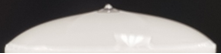
Wetting issues can range from minor to severe (see previous images). Severe wetting issues often result in an underfilled well and if severe enough (see comparison of fills below), an accurate egg count cannot be achieved.

 |
 |
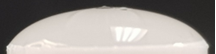 |
| 435 µL – ‘under’ | 445 µL – ‘good’ | 455 µL – ‘over’ |
Troubleshooting steps
- Wash in soapy water
- If you are still having issues: Fill the wells of the cassette with warm, soapy water (dish detergent is perfect for this), and soak them for 10 minutes. Rinse wells with clean running water to ensure all soap is removed before use. Be sure to rinse the cassette with water after each use.
- If you are still having issues: Flatten a cotton tip, dip the cotton tip in warm soapy water, and in a circular twisting motion clean each rod tip NB: please be very careful when completing this step as excess pressure could cause the rod to break. Rinse the wells clean and repeat step two above
NB: Avoid touching the rods with your fingers or cloth as it can cause wetting issues. If you do accidentally follow step 2 above.